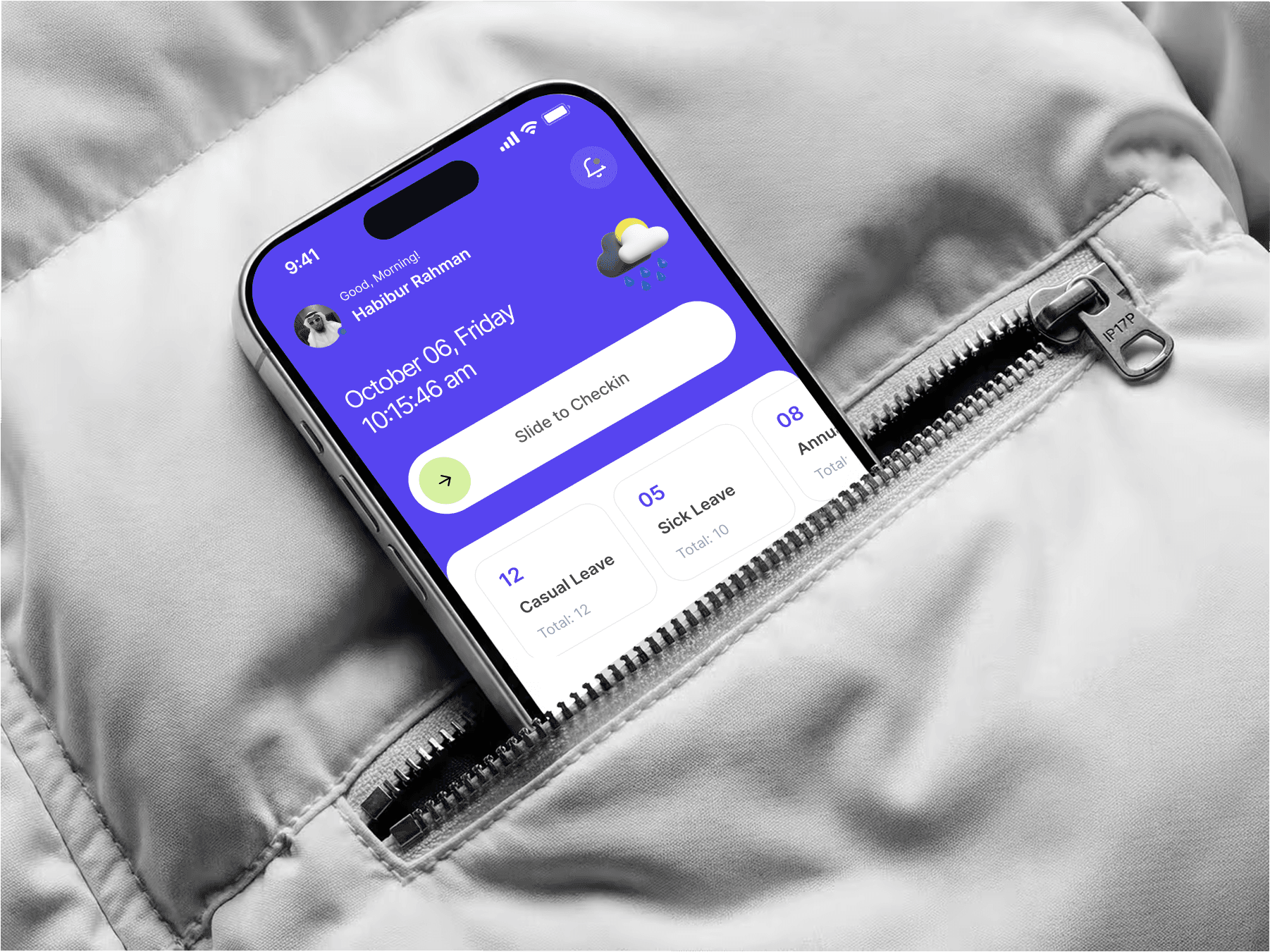
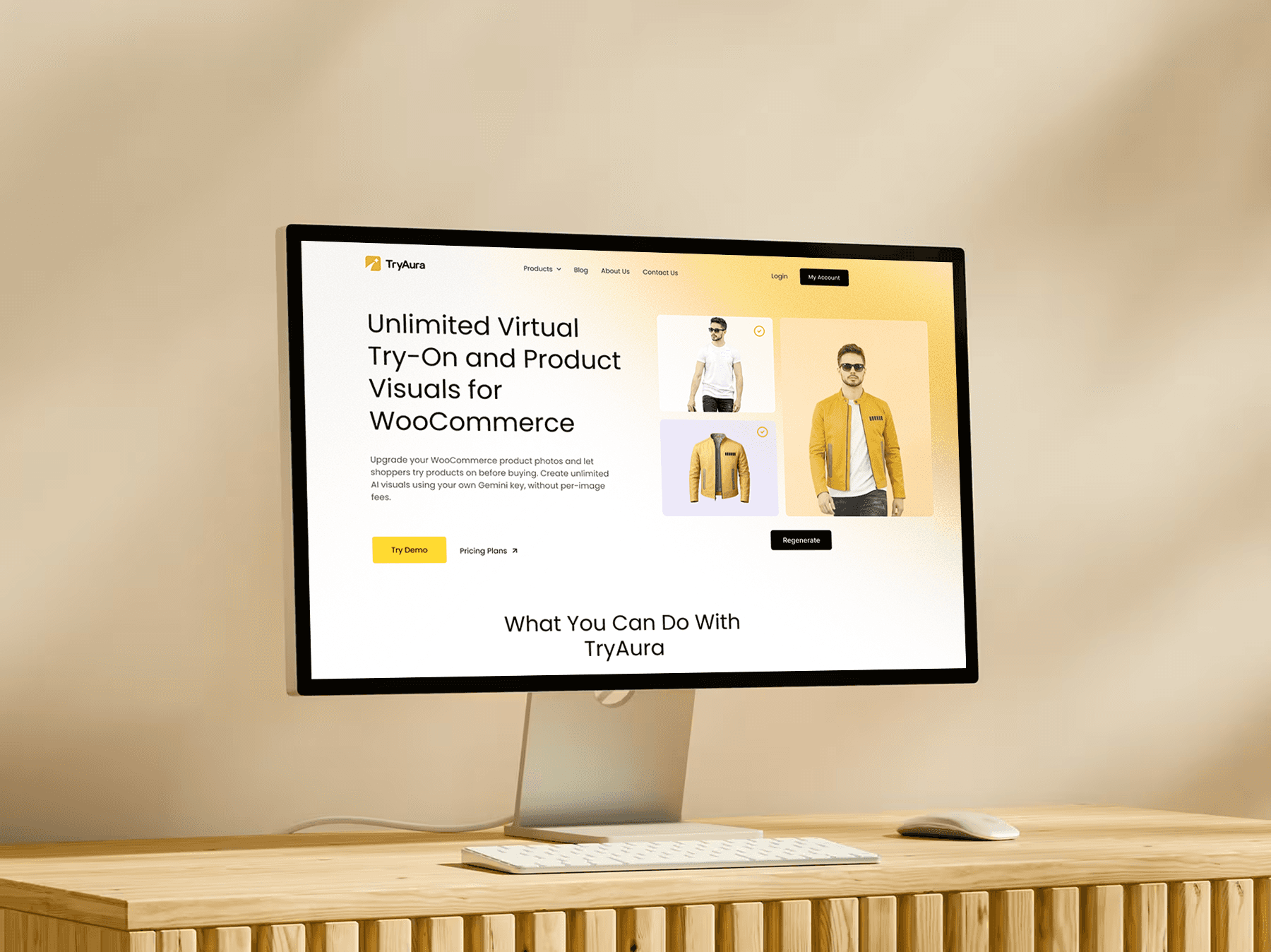
TryAura is a revolutionary WooCommerce plugin designed to solve one of the most persistent challenges in fashion e-commerce: the fit and look mismatch. By combining advanced AI Virtual Try-On (VTO) with on-brand content generation, TryAura empowers brands to instantly visualize garments on realistic AI-generated models without the need for expensive photoshoots and, crucially, without per-image fees by utilizing the user's own Gemini key. This case study details the design process for the TryAura marketing website, focusing on how we translated complex AI capabilities into a compelling, user-centric narrative for small to medium-sized business (SMB) owners.
The primary objective of the TryAura marketing website was to clearly communicate the unique value proposition of this unified solution to our target audience. We established the following goals: • Educate and Convert: Clearly explain how TryAura bridges the gap between VTO and AI content generation within WooCommerce, driving plugin installations and subscriptions. • Build Trust: Establish TryAura as a premium, reliable tool through high-fidelity visual design and clear demonstrations of the technology's capabilities. • Streamline Onboarding: Guide users intuitively from understanding the problem to visualizing the solution and finally, to taking action (e.g., viewing a demo or signing up).
The Problem
The fashion e-commerce industry faces a massive financial drain, losing an estimated $428 billion in revenue annually due to returns caused by fit and look mismatches. For brands, producing high-quality product photos is a significant bottleneck, costing thousands of dollars per product line and requiring models, studios, and elaborate setups.
Simultaneously, shoppers frequently abandon their carts because they cannot convincingly visualize how a product will look on them or in a real-world setting. The core challenge was that existing solutions were fragmented: brands either used basic VTO plugins that lacked realism, standalone AI image generators that required separate, cumbersome workflows outside of their WooCommerce environment, or incurred prohibitive per-image costs. There was a clear market gap for a unified, integrated solution that offered unlimited creation at a predictable cost.
Research & Insights
Our design strategy was heavily informed by comprehensive market research and competitor analysis. We identified that TryAura sits at the intersection of three rapidly growing sectors: the VTO market (projected >20% CAGR), the AI-Generated Content market, and the massive WooCommerce Plugin Ecosystem.
Competitor Analysis:We analyzed both direct competitors (WooCommerce plugins like VirTry and ImaJinn AI) and indirect competitors (SaaS tools like Photoroom, Pebblely, and enterprise solutions like ZegoCloud).
Insight: Direct competitors offered either VTO or AI image generation, but rarely both with high realism. Indirect competitors offered powerful tools but lacked native WooCommerce integration, creating friction for store owners.
Design Action: This insight directly influenced our messaging hierarchy. We needed to emphasize "All-in-One Creativity" (combining VTO and AI content generation) and "Fits Natively In Your Workflow" (seamless WooCommerce integration) as key differentiators on the landing page, prominently featured in the UI.
Target Users
The primary audience for TryAura is SMB owners utilizing WooCommerce. To ensure our design resonated, we segmented this audience into specific verticals:
•Fashion and Apparel Stores: Retailers needing critical fit and style visualization.
•Jewelry and Watch Retailers: Businesses where VTO is a major value-add.
•Eyewear and Sunglasses Shops: A classic, high-demand use case for VTO.
•Cosmetics and Beauty Brands: Requiring specialized, high-fidelity VTO.
•Dropshippers and Boutiques: Store owners needing fast, affordable ways to create unique, on-brand visuals from generic supplier photos.
•Tech-Savvy Entrepreneurs: Early adopters seeking tools to optimize stores and reduce costs.
Understanding these diverse needs meant the website had to showcase versatility—demonstrating that TryAura works seamlessly across different product categories.
Design Process
We adopted a Lean UX methodology, focusing on rapid iteration and continuous alignment with business goals. The process moved from initial strategic alignment (based on the R&D data) to information architecture, wireframing, and finally, high-fidelity visual design. At each stage, we prioritized clarity, ensuring that the complex AI technology was presented in an accessible, benefit-driven manner.
Information Architecture (IA) & User Flows
The IA was structured to guide the user through a logical narrative arc:
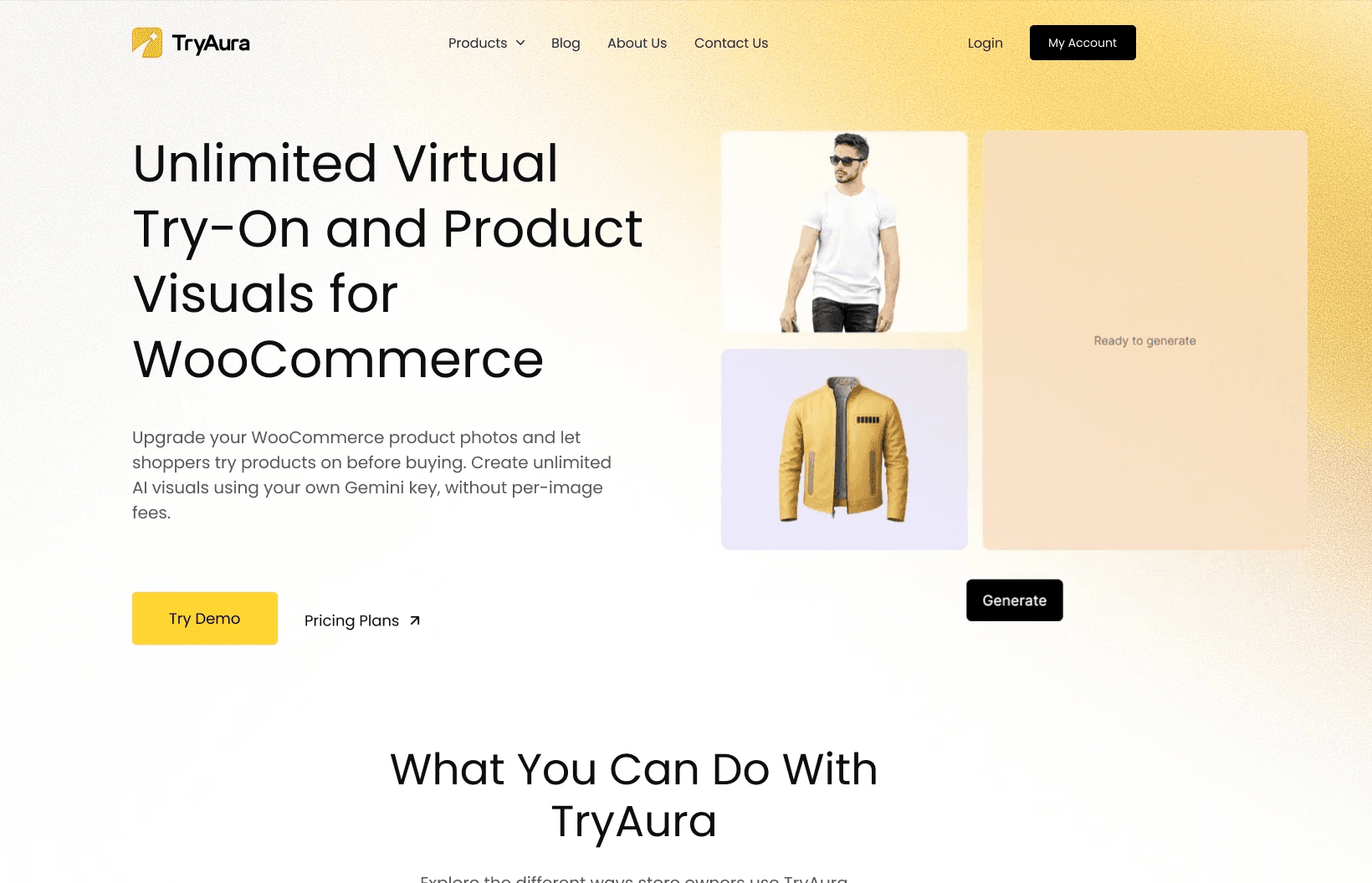
1.Hero Section: Immediate value proposition ("Unlimited Virtual Try-On and Product Visuals for WooCommerce") with a clear Call to Action (CTA).
2.Feature Showcase ("What You Can Do"): Interactive tabs allowing users to explore different use cases (e.g., Try On Accessories, Change Model, Change Background), directly addressing the segmented target audience.
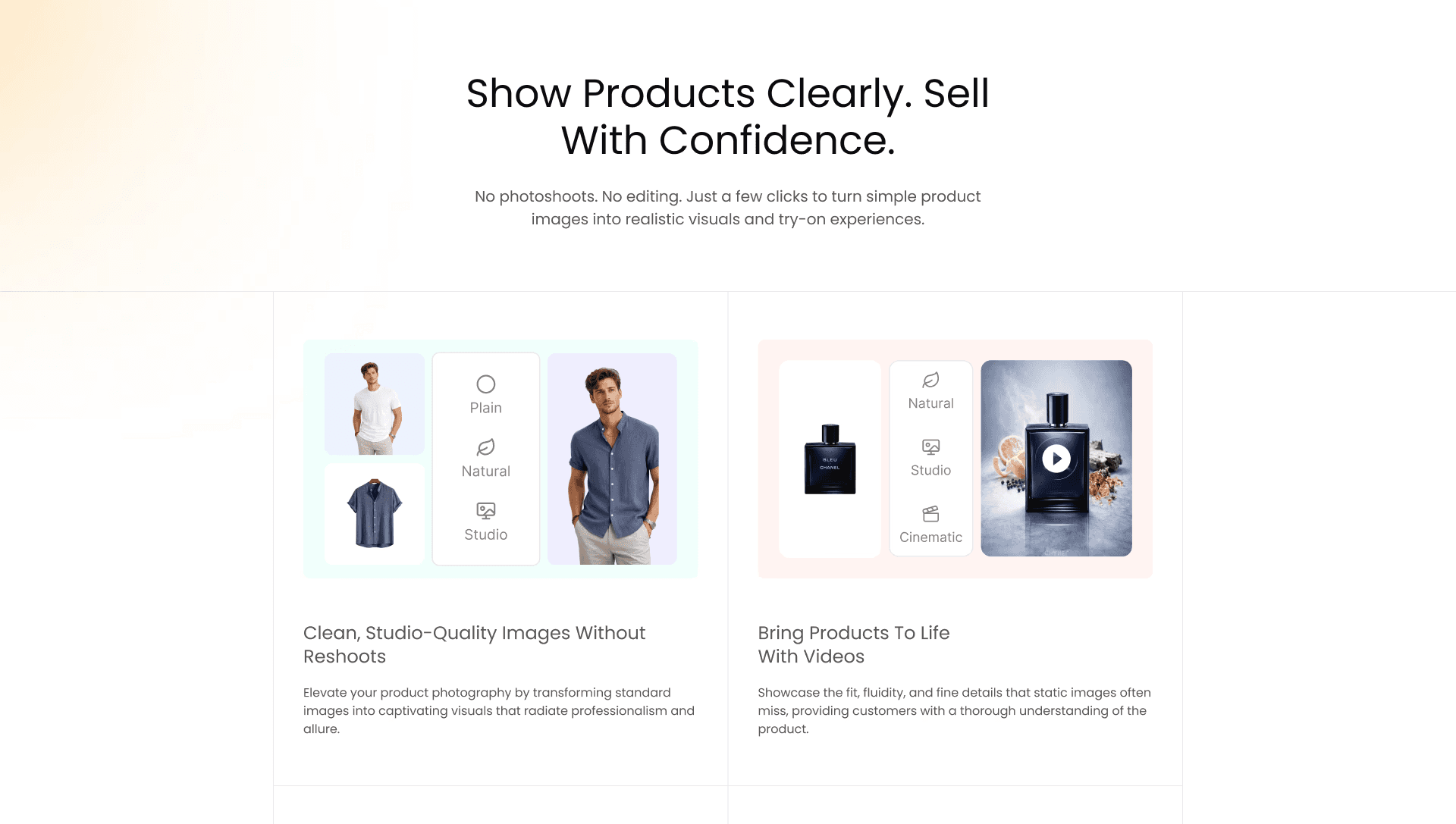
3.Benefit Pillars ("Show Products Clearly"): Highlighting the core advantages: studio-quality images, bringing products to life, and unlimited variations.
4.Integration ("Fits Natively In Your Workflow"): Crucial section demonstrating the seamless WooCommerce integration, addressing the pain point identified in competitor research.
5.Process ("How TryAura Works"): A simplified, step-by-step breakdown of the user journey.
6.FAQ & Footer: Addressing common objections and providing secondary navigation.
This flow ensures users understand what the product is, why it's better than alternatives, and how easily they can adopt it.
Visual Design
The visual design language was crafted to evoke innovation, clarity, and premium quality.
•Color Palette: We utilized a clean, predominantly white and light cream background to allow the high-quality AI-generated product imagery to stand out. A vibrant, energetic yellow/gold was chosen as the primary accent color for CTAs and key highlights, drawing the user's eye to critical conversion points.
•Typography: A modern, sans-serif typeface was selected for its readability and contemporary feel, ensuring that technical information remained accessible.
•Imagery: The design heavily relies on showcasing the actual output of the TryAura plugin. By displaying realistic models and diverse product categories (clothing, accessories, perfumes) directly on the page, we provide immediate visual proof of the product's capabilities.
Interactions & Microcopy
Interactive elements were strategically placed to enhance engagement without overwhelming the user.
•Interactive Feature Tabs: In the "What You Can Do" section, users can click through different tabs (e.g., "Try On Clothing," "Try On Accessories," "Change Model," "Product Videos"). This micro-interaction allows users to self-select the use case most relevant to their specific vertical, making the experience personalized and demonstrating the breadth of TryAura's capabilities.
•Step-by-Step Visualization: The "How TryAura Works" section uses a clear, numbered, sequential layout (01, 02, 03, 04) to demystify the AI process, breaking it down into simple, understandable steps like "Choose a Product," "Generate Visuals," "Enable Virtual Try-On," and "Publish." This simplifies a potentially complex workflow for the user.
•Microcopy: Headings are benefit-driven (e.g., "Show Products Clearly. Sell With Confidence.") rather than feature-driven. Button labels are action-oriented ("Try Demo," "Pricing Plans"), guiding the user clearly toward the next step. The expandable FAQ section uses natural language questions to address specific user concerns (e.g., "Do I need professional product images to use TryAura?").
Design System (Optional but Recommended)
While a formal, extensive design system was not the primary focus for this marketing website, core elements of a systematic approach were applied to ensure consistency and scalability. This included:
•Consistent Branding: Adherence to a defined color palette (yellow/gold accents, clean whites/creams) and typography across all sections.
•Reusable Components: Standardized button styles, card layouts for features, and consistent iconography were used throughout the site, ensuring a cohesive visual experience.
•Responsive Design Principles: The design was inherently responsive, adapting gracefully to various screen sizes to provide an optimal viewing experience for all users.
This foundational consistency ensures that as TryAura evolves, new pages and features can be integrated seamlessly, maintaining a strong brand identity and user experience.
Handoff & Implementation
The TryAura marketing website was designed to support the launch and adoption of the TryAura WooCommerce plugin. The successful development and release of the plugin on WordPress.org signifies a critical phase of the project, moving from design concept to a live, functional product available to a global community of WooCommerce store owners.
•WordPress.org Integration: The plugin is officially listed on WordPress.org, ensuring discoverability and ease of installation for its target audience. This platform provides a trusted channel for distribution and ongoing updates.
•Seamless WooCommerce Integration: As observed on the live site and detailed in the R&D, the plugin is built to integrate directly into the WooCommerce product editor and Media Library, minimizing friction for merchants.
•Community Engagement: The WordPress.org platform facilitates direct engagement with users through reviews and support forums, providing valuable feedback for future iterations.
Outcomes & Learnings
The resulting marketing website successfully translates a complex, highly technical product into a compelling, user-centric narrative. By deeply integrating market research and competitor analysis into the design process, we created a landing page that not only looks premium but strategically positions TryAura as the definitive all-in-one VTO and content generation solution for WooCommerce.
Key Takeaway: Designing for AI products requires a delicate balance. The technology is complex, but the user experience must be simple. By focusing relentlessly on the user's end goal—selling more products with confidence—we were able to design a website that effectively communicates the transformative power of TryAura.